
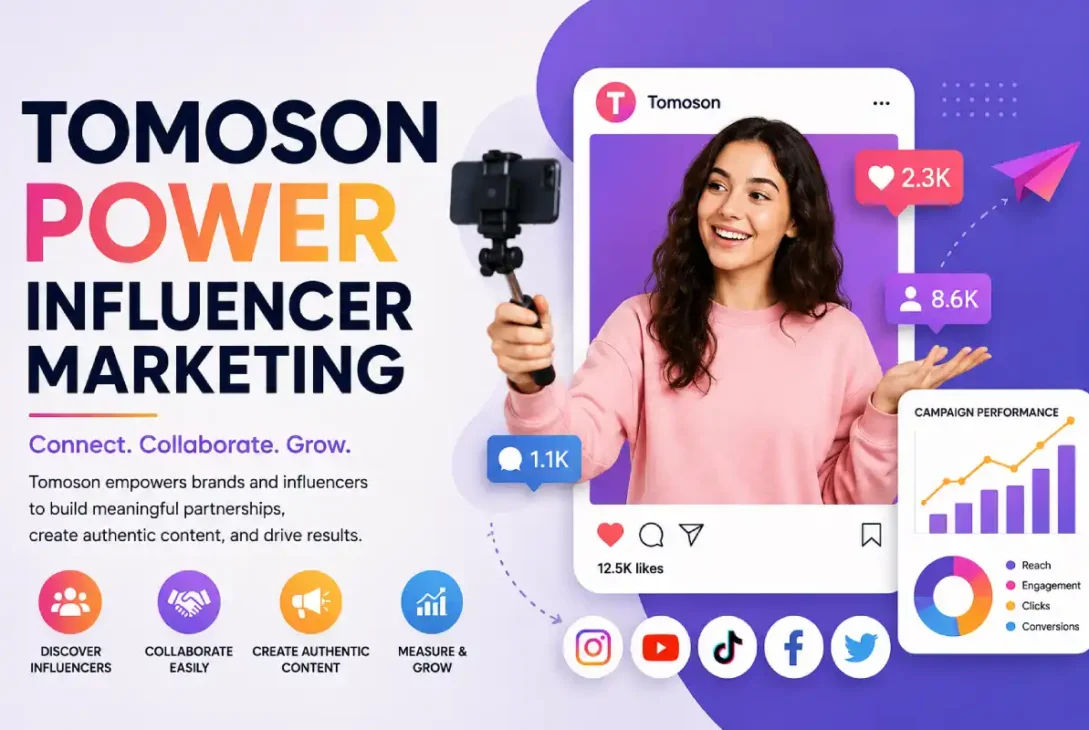
Marketing new products to an online following through social media, by working with brands and influencers, can be achieved differently than traditional commercials and marketing campaigns. To understand what works in this space, let’s discuss how Tomoson uses influencers for marketing, product collaboration, and content.
What Is Power Influencer Marketing via Tomoson? To understand Tomoson for brand engagement, first, know where their focus resides. The company describes itself as a resource for social marketing, influencer marketing, digital business, and more, and can offer some useful resources by leveraging brand outreach, campaign promotion, and measurable work, including blog articles on identifying influencers, a campaign launch plan, and the benefits of AI.
In simple terms for brands: select relevant personalities with influence in a particular space; tell them what you want out of a product campaign; allow them to post engaging, value-driven content; monitor what happened as a result.
What Is Tomoson Power Influencer Marketing?

Tomoson power influencer marketing can be boiled down to using Tomoson’s campaign tactics and influencer-marketing ecosystem to identify influencers and engage them in campaigns. Influencer marketing is finding people with audiences whom you ask to show or tell how to promote and rave about a product. The key phrase here in this definition is relevance.
The number of followers isn’t the key indicator; a micro-influencer with the right demographic for a product could potentially be more effective than a megastar.
Tomoson’s influencer guidelines cover campaigning prerequisites, approval, campaign tasks, communication, content, and verification, which outline the steps for setting up and managing an influencer campaign.
How Does Tomoson Influencer Marketing Work?
It is also fairly common to see that any campaign starts with the brand determining what it actually wants to get out of it
The objective could be:
- Product awareness
- Website traffic
- Social media exposure
- Reviews
- Tutorials
- Images or videos
- User-generated content
- Sales
- Feedback
- Product launches
Once the goals are set, the brands then write down campaign requirements. Influencers can apply if they fit the requirements of the campaign, and brands can approve those who are qualified as influencers.
The brand’s FAQ of the brand for Tomoson also mentions that brands can message influencers through the invite and inbox tools of the system, and a view of the work they’ve completed is also available.
This matters because influencer campaigns are difficult to track when their conversations, deadlines, products, content specifications, and links are separated.
Why Is Influencer Marketing So Powerful?
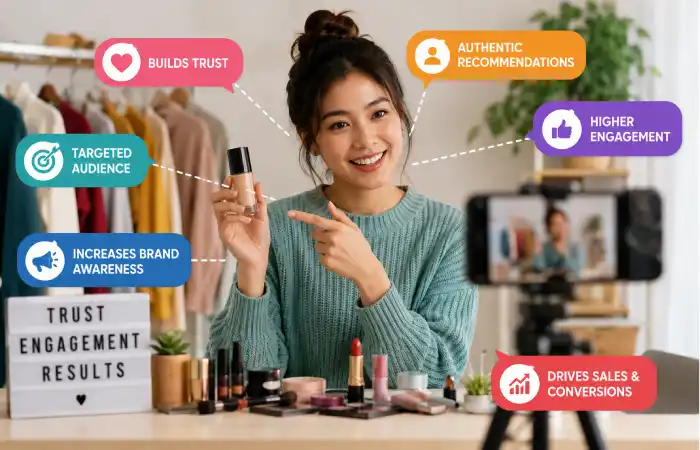
How influencer marketing isn’t your typical banner ad: An influencer recommendation feels personal, even though they’re also being paid. Unlike, say, a banner ad, which an audience can immediately categorize as trying to make a sale, an influencer comes from within their feed – one of a personal circle of contacts. Just because this can be delivered personally doesn’t mean that every influencer marketing campaign works, though, because credibility can go out the window once a brand appears on a creator that doesn’t normally discuss it or similar things.
Trust and transparency: The Tomoson blog mentions that brand affinity, genuineness, and trust are three pillars behind why the concept of influencer marketing is so effective.
Good campaigns and strategies therefore take the time to understand who they want to reach, not just how many eyes.
Tomoson Power Influencer Marketing vs Traditional Advertising
The two approaches can complement each other, but they operate differently.
| Factor | Tomoson Influencer Marketing | Traditional Advertising |
| Main strength | Creator trust and targeted audiences | Broad paid exposure |
| Communication style | Personal and creator-led | Brand-controlled |
| Content | Reviews, demonstrations, posts, videos | Ads, banners, commercials |
| Audience relationship | Usually community-based | Usually transactional |
| Targeting | Based heavily on creator relevance | Based on advertising targeting |
| Measurement | Reach, engagement, traffic, conversions, and campaign tasks | Impressions, clicks, conversions, and reach |
| Creative control | Shared with creator | Mostly controlled by advertiser |
Neither approach is automatically better.
A company selling a highly visual consumer product may benefit enormously from creator demonstrations. A company trying to reach millions of people quickly may still find paid advertising useful.
The strongest marketing strategies often combine both.
The Role of Micro-Influencers
One of the most interesting parts of modern influencer marketing is the rise of micro-influencers.
A micro-influencer generally has a smaller following than a celebrity or major creator but often has a highly focused community.
For example, imagine two creators:
Creator A: 500,000 followers covering general lifestyle topics.
Creator B: 18,000 followers who regularly discuss home coffee equipment.
If a company sells an espresso accessory, Creator B may be the more logical choice.
Tomoson’s small-business guidance specifically recommends considering micro- and nano-influencers, authenticity, engagement, and relevance rather than relying only on audience size.
That is an important lesson for businesses with limited marketing budgets.
Key Features of Tomoson Influencer Campaigns
1. Campaign Creation
Brands can create campaigns around specific products, services, or marketing objectives.
According to Tomoson’s brand FAQ, campaigns can cover physical products, ebooks, apps, services, events, and product launches, subject to its rules.
2. Influencer Applications
Creators can look for campaigns they’re a good match for and apply. Brands can create rules (e.g., website visits) on required audience size, the category they operate in, etc.
3. Creator Approval
Influencer acquisition is the first step.
Still, for the brand on their side, whether creators fit the brand image or not. Hence there would be another space for content value, audience value, engagement value and campaign relevance.
4. Campaign Communication
One of the most unglamorous but vital aspects of influencer marketing is clear communication.
Creators have to be aware of what they’re supposed to be creating, by what date they are to deliver, and what campaign guidelines they must adhere to.
Tomoson provides an invite system and message center for campaign-related communication.
5. Product-Based Campaigns
Many influencer campaigns involve sending a product to a creator.
Tomoson’s influencer FAQ notes that most products in its campaigns are provided at no charge, although some may be offered at a discount depending on the campaign.
This model can be particularly useful for physical products that benefit from demonstrations or hands-on reviews.
Measuring the Success of Tomoson Power Influencer Marketing
A campaign should never be judged solely by how many followers an influencer has.
A better approach is to establish measurable goals before the campaign begins.
Important metrics can include:
- Impressions
- Reach
- Engagement rate
- Comments
- Shares
- Website visits
- Click-through rate
- Affiliate sales
- Coupon-code usage
- Conversion rate
- Cost per acquisition
- Return on investment
Tomoson’s own strategy guidance recommends beginning with clearly defined objectives and understanding the target audience before selecting influencers.
Why ROI Matters
Suppose a brand spends $2,000 on an influencer campaign.
The creator generates 80,000 impressions. That number looks impressive, but impressions alone do not tell the whole story.
If the campaign produces only $500 in attributable sales, the business needs to investigate what went wrong.
On the other hand, a campaign producing 15,000 highly relevant views and $8,000 in attributable sales could be much more valuable.
Good influencer marketing is not a popularity contest. It is a business exercise.
Advantages of Tomoson Power Influencer Marketing
Better Audience Relevance
Brands can search for creators whose audiences match their products rather than simply purchasing broad advertising exposure.
More Authentic Content
Influencers can present products in their natural content style. A tutorial or personal demonstration may feel more useful than a conventional advertisement.
Useful for Smaller Brands
Smaller businesses do not necessarily need celebrity-level budgets. Micro-influencers can provide access to focused communities.
Multiple Content Possibilities
Influencer campaigns can produce reviews, photographs, videos, tutorials, social posts, and other forms of content.
Organized Campaign Management
Centralizing applications, communication, requirements, and completion tracking can reduce the administrative work involved in influencer campaigns. Tomoson’s platform documentation describes these campaign-management functions directly.
Potential Limitations to Consider
No influencer platform eliminates the need for good marketing judgment.
A campaign can still fail if the brand chooses the wrong creator, provides weak campaign instructions, sends an unsuitable product, or measures the wrong outcomes.
Another issue is content quality. A creator may have a large audience but produce content that does not match the brand’s image.
There is also the question of disclosure and compliance. Influencer campaigns need to follow applicable advertising and platform rules. Tomoson states that influencers can face account restrictions for violations involving FTC guidelines and its review policies.
Brands should therefore treat compliance as part of campaign planning rather than something to worry about afterward.
Tomoson vs Other Influencer Marketing Approaches
| Approach | Best For | Main Advantage | Main Challenge |
| Tomoson-style marketplace campaigns | Product-focused brands and creators | Structured campaign workflow | Requires careful creator selection |
| Direct influencer outreach | Experienced marketing teams | More relationship control | Time-consuming |
| Affiliate marketing | Sales-focused campaigns | Easy performance attribution | Requires compelling offers |
| Paid social advertising | Scalable reach | Strong targeting and control | Can become expensive |
| Organic creator partnerships | Long-term brand building | Authentic relationships | Slower to scale |
The right option depends on the business objective.
A brand launching a new product may combine product seeding, creator content, paid amplification, and affiliate tracking rather than relying on only one method.
How to Build a Strong Tomoson Influencer Campaign
Step 1: Define the Goal
Do not start with, “We need influencers.”
Start with:
What result do we want?
Awareness, sales, reviews, traffic, content creation, and product feedback require different campaign structures.
Step 2: Understand Your Customer
Create a simple description of your ideal buyer.
Consider:
- Age group
- Location
- Interests
- Buying habits
- Problems
- Preferred platforms
- Content preferences
Step 3: Choose Relevance Over Fame
Look at the creator’s actual content.
Ask yourself:
Would this audience realistically care about my product?
If the answer is no, a large follower count does not solve the problem.
Step 4: Write Clear Requirements
Creators should know what the campaign expects.
Explain the product, deliverables, deadlines, content requirements, links, disclosure requirements, and other important conditions.
Step 5: Let the Creator Be Human
Over-controlling every sentence can make sponsored content feel artificial.
Give creators the information they need, but allow them enough creative freedom to communicate naturally with their audience.
Step 6: Measure the Results
Track campaign performance after publication.
Look beyond vanity metrics and determine whether the campaign contributed to the actual business objective.
Is Tomoson Power Influencer Marketing Worth It?
For brands interested in structured influencer campaigns, Tomoson can be worth considering, particularly when the campaign involves products, reviews, content creation, or creator partnerships.
It is especially interesting for businesses that want to organize the influencer process instead of manually managing every conversation through email and social media.
However, the platform itself is not a substitute for strategy.
A weak product with unclear positioning will not suddenly become successful because it is promoted by an influencer. Likewise, an irrelevant creator can waste an otherwise reasonable campaign budget.
The real power comes from putting the right product in front of the right audience through the right creator with the right campaign objective.
Frequently Asked Questions
What is Tomoson power influencer marketing?
It refers to using Tomoson’s influencer marketing platform and campaign approach to connect brands with relevant creators, organize campaigns, distribute products or offers, and manage creator deliverables.
Is Tomoson free for influencers?
Tomoson’s current influencer FAQ states that influencers can use Tomoson for free.
What types of campaigns can brands create?
Tomoson says campaigns can include physical products, ebooks, apps, services, events, and product launches, depending on its policies.
Do influencers need millions of followers?
No. A smaller creator with a highly relevant and engaged audience can be valuable, particularly for niche products. Tomoson specifically discusses micro- and nano-influencer strategies for smaller businesses.
What should brands measure?
Brands should select metrics based on their objective. Useful measurements include reach, engagement, clicks, conversions, sales, coupon usage, customer acquisition cost, and ROI.
Final Thoughts
The Tomoson power influencer marketing is an echo of a greater trend in the digital marketing landscape that revolves around consumers responding to the most valuable and engaging content and to the personality associated with it, instead of just another product push. Tomoson creates structure around influencer campaigns. Its educational content aims to cover aspects like researching the audience, fitting the creator and offering, ensuring authenticity, planning the campaign, and measuring success.
Also Read: https://www.nextleveltechie.com

 Welcome To Next Level Techie, For any queries you can contact us at :