

In running a small business, we wear so many different hats-the owner, the salesperson, the customer service rep, the accountant, and perhaps even the social media poster. It can be a ton to keep track of, and marketing is a function we find ourselves wanting to do “later”.
But marketing doesn’t have to cost a lot.
A good marketing plan for small business owners means that they understand their audience and have a core message in place. They also should have a presence where customers gather and utilize ongoing marketing activities to spread word of mouth.
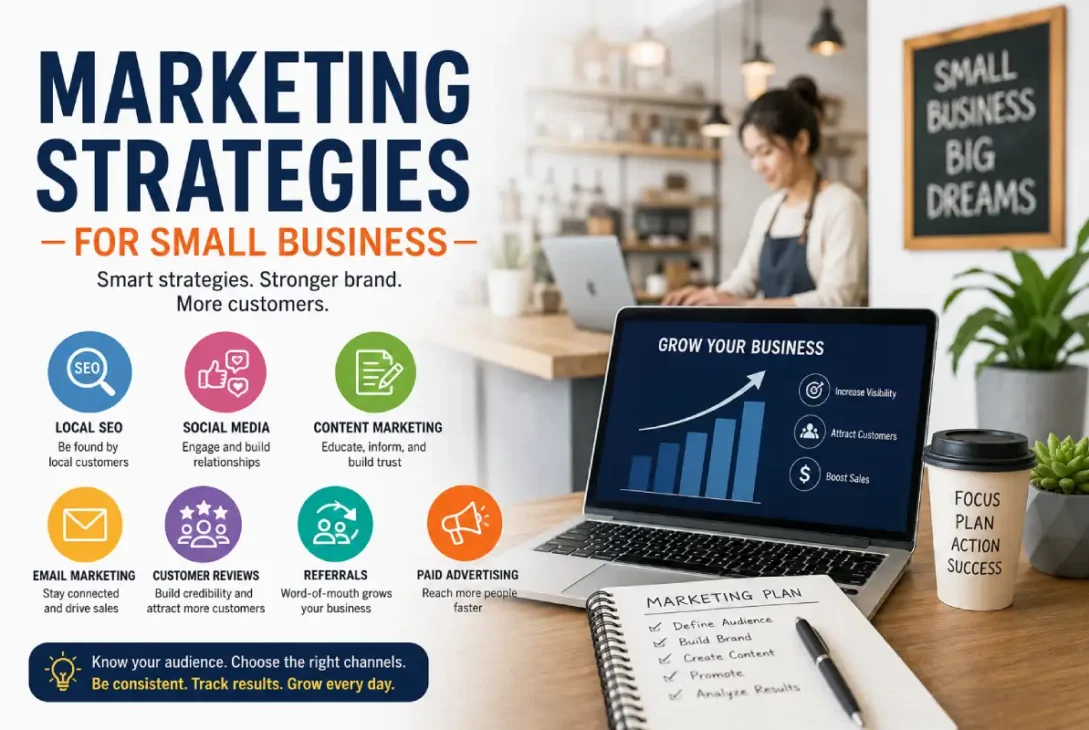
A straightforward plan that is executed well can sometimes outdo a complicated marketing campaign no one understands. In this article, we will dive into some of the most practical ways for a small business owner to effectively market their business, from local SEO and social media to email, content marketing, referrals, and advertising.
What Are Marketing Strategies for Small Businesses?

Small Business Marketing: What do I mean by “Small business marketing plan”? I mean a guide to find new prospects, build credibility, drive sales, and keep them coming back for the brand. It’s not just about posting an Instagram ad or placing a banner advertisement.
The strategy answers key questions such as.
- Who are your ideal customers?
- What problem does your business solve?
- Why would customers buy from you?
- What other places could your customer’s hang out?
- How much can you afford to spend on marketing?
- How do you measure your success?
The most successful small business marketing campaigns link these questions and formulate a workable action plan. A local bakery, for example, could utilise Google presence and local social media, referrals, seasonal promotions, and e-mail notifications.
A software consultant could benefit from the local presence of LinkedIn, content marketing and educational articles, and networking.
There is no exact marketing recipe; the right one depends on your audience, location, industry, resources, and objectives.
Why Marketing Matters for Small Businesses

A fantastic product, in itself, cannot create satisfied customers. The public has to know your business exists so they even have a chance to make purchase orders! Without marketing, no one would ever make the connection between your goods or services and the consumers who might be looking for them. Effective Marketing Assistance for Small Businesses
- Increase brand awareness
- Bring in new customers
- Build trust
- Generate qualified leads
- Increase repeat purchases
- Compete with larger businesses
- Develop a recognizable brand
- Create long-term customer relationships
The other significant factor that gives small businesses the edge is the personal factor. A local business can respond to people and share stories that genuinely reflect the business in ways a large corporation finds very difficult to replicate, and that personal relationship should definitely be safeguarded.
1. Define Your Target Audience First
Before putting money into advertising, determine whom you really want to reach.
A target audience is a specialized group who will benefit from your product or service. You need to be the ones who need, want, and buy your product.
Consider:
- Age range
- Location
- Occupation
- Income level
- Interests
- Buying habits
- Common problems
- Preferred communication channels
- Reasons for choosing one business over another
For example, a small fitness studio’s target might be working people within a radius of a few km looking to get a workout in in the evening. Instead of broadly targeting ‘People looking for fitness’, such a definition is very practical.
Create a Simple Customer Profile
Write down a realistic description of your best customer.
Ask yourself:
Who is this person, what do they want, what makes them frustrated, and how can I make them trust me/my business?
The answer can range from your website wording to social media posts and anything in between.
2. Build a Strong Local SEO Presence
If a company’s customers are only in the immediate area, local SEO can sometimes be the most valuable marketing tool of all.
What it is: local SEO is all about increasing visibility when users look for products or services in a certain geographic area.
A user looking for “plumber near me,” “best cafe in Hyderabad”, or “accountant near me” already has buying intent (otherwise, why would they be searching on Google.com?). Showing up during these searches ensures you get put in front of potential customers.
To begin, you’ll want to ensure your Google Business Profile is up to date.
Make sure your listing contains:
- Correct business name
- Address
- Phone number
- Opening hours
- Website
- Business category
- High-quality photographs
- Relevant services
- Customer reviews
Keep the information updated. An outdated phone number or incorrect opening time can quickly turn a potential customer away.
Reviews Are Part of Your Marketing
Customer reviews are more than social proof. They can influence whether a new customer decides to contact you.
After a successful purchase or service, politely invite satisfied customers to leave an honest review. Never pressure customers to leave misleading reviews.
3. Use Social Media With a Purpose
The strength of social media, here is a mistake we small businesses make. We are doing it everywhere.
You really don’t need five social media profiles. Pick a social media platform or two where your customers frequent. Using social media platforms to gain awareness, communicate with consumers, distribute useful content and further business needs.
A restaurant might benefit from Instagram and Facebook. A professional service provider may find LinkedIn more useful. A visually driven business could benefit from platforms centered around images and video.
What Should You Post?
Do not make every post a sales pitch.
A useful content mix might include:
- Product demonstrations
- Behind-the-scenes moments
- Customer stories
- Helpful tips
- Frequently asked questions
- Educational videos
- New-product announcements
- Special offers
- Business milestones
- Short industry insights
People are more likely to pay attention when your content gives them a reason to stop scrolling.
4. Create Useful Content
Content marketing is the practice of creating and distributing useful information to attract and educate a specific audience.
A small business can use content to demonstrate expertise before asking someone to buy.
For example, a landscaping company could publish:
- “How Often Should You Water a New Lawn?”
- “Five Signs Your Garden Needs Better Drainage”
- “How to Choose Plants for a Hot Climate”
These topics answer real questions. They also allow potential customers to discover the business through search engines.
The goal is not to create content simply because the internet says you should.
The goal is to create content that solves a problem your potential customer actually has.
5. Invest in Email Marketing
Social media grants you access to an audience, but the channel itself is not under your entire command.
Email marketing is a more direct form of communication.
Email marketing refers to delivering informative, promotional, or relational messages to willing recipients.
A small business could use email for:
- Welcome messages
- Product announcements
- Educational tips
- Seasonal promotions
- Special customer offers
- Appointment reminders
- New-content notifications
- Re-engagement campaigns
Avoid sending emails simply because you have an email list. Every message should have a purpose.
A short, genuinely useful email can be more effective than a long newsletter filled with advertisements.
6. Encourage Customer Referrals
Occasionally, your happiest customers may be your best marketers. Referral marketing: existing customers who refer a business to their friends, family, coworkers, or other possible consumers. We do rely on the advice of individuals that we trust.
We will advertise referrals through outstanding service, as well as, when applicable, an extremely simple referral system.
Example: “Refer a friend as well as get a discount on a future service once they become a customer.” The exact inducement depends on your business model; it could be price cuts, debt, small presents, etc. Never undervalue, nevertheless, how vital it could be to merely assist your consumers in feeling appreciated. A consumer who genuinely loves your solutions might refer you simply because you’re justifiably excellent, with no reason.
7. Build Partnerships With Other Local Businesses
Small businesses do not always have to market alone.
Look for businesses that serve a similar audience without directly competing with you.
For example:
- A photographer could partner with an event planner.
- A café could collaborate with a nearby bookstore.
- A fitness trainer could partner with a sportswear business.
- A wedding service provider could connect with florists and venues.
These partnerships can create cross-promotional opportunities.
You may be able to exchange referrals, organize events, create bundled offers, or produce content together.
The best partnerships are mutually beneficial rather than one-sided.
8. Try Paid Advertising Carefully
Paid advertising can produce faster visibility, but it should be approached carefully when your budget is limited.
Common options include:
- Search advertising
- Social media advertising
- Display advertising
- Local advertising
- Sponsored content
The most important question is not, “How much should I spend?”
It is:
“What result am I expecting from this spending?”
If you spend $500 and generate $1,500 in profitable sales, that tells you something useful. If you spend $500 and receive thousands of clicks but no meaningful customers, you need to investigate what went wrong.
Start small. Test one audience, one offer, and one message before increasing your budget.
9. Improve Your Website
Your website is often the place where marketing turns into action.
A beautiful website is helpful, but clarity matters more.
Visitors should quickly understand:
- What you offer
- Who you serve
- Why they should trust you
- What they should do next
Your website should have clear calls to action such as:
- Call us
- Request a quote
- Book an appointment
- Shop now
- Contact us
- Subscribe
- Schedule a consultation
Make sure the site works well on mobile devices. Many potential customers will encounter your business through a smartphone.
10. Focus on Customer Retention
Marketing isn’t just about acquiring new customers.
Customer retention is about giving current customers a reason to keep buying your products. It may even be more important to keep current customers, as they have established knowledge of your business and have had experience of the product/service.
Retention strategies can include:
- Loyalty programs
- Personalized offers
- Follow-up messages
- Excellent customer support
- Exclusive access
- Helpful post-purchase information
- Birthday or anniversary offers
- Regular customer appreciation campaigns
A customer who returns several times can become more valuable than someone who makes a single purchase and disappears.
Marketing Strategy Comparison for Small Businesses
| Strategy | Best For | Cost Level | Main Advantage | Main Challenge |
| Local SEO | Local businesses | Low–Medium | Captures local search demand | Takes time to build |
| Social media | Brand awareness and engagement | Low–Medium | Direct audience interaction | Requires consistency |
| Content marketing | Education and organic traffic | Low–Medium | Builds authority over time | Results may be slow |
| Email marketing | Repeat customers | Low | Direct communication | Requires a quality list |
| Referrals | Trust and customer acquisition | Low | Personal recommendations | Depends on customer satisfaction |
| Paid advertising | Faster reach | Medium–High | Quick exposure | Can become expensive |
| Partnerships | Local growth | Low | Shared audiences | Finding suitable partners |
How to Choose the Right Marketing Strategy
Do not try everything simultaneously.
Instead, begin with three questions:
What Is My Goal?
Your goal might be:
- More website visitors
- More phone calls
- More store visits
- More leads
- More online orders
- More repeat customers
Choose strategies that directly support that objective.
Where Are My Customers?
If your customers find what they are looking for by typing into Google, SEO could be considered.
>If, however, users find your products visually, social media could be the one for you to consider more closely.
>If you already have established customer relationships, email and word of mouth may be highly effective.
What Can I Sustain?
Consistency wins over two weeks of enthusiasm.
Even in your early stages of business as an entrepreneur, two posts that provide value in a week can keep going for longer in a year than a marketer who is posting fifteen articles and then vanishing for an entire month. Find a marketing routine that is manageable for you.
A Simple Small-Business Marketing Plan
If you’re at ground zero, don’t try too much at first.
>Month 1: Identify who your customer is, optimize your website, establish a local business listing, and set up profiles where your customer really is.
>Month 2: Publish your helpful content, gather legitimate reviews, build your email list.
>Month 3: Try a referral campaign or simple paid ad campaign and analyze what really happens.
Then do more of what actually moves the dial for your business and put more energy there.
There is no need to be good at ALL marketing.
What you need is to find which marketing consistently leads customers to your business.
Common Small-Business Marketing Mistakes
Even good strategies can fail when the basics are ignored.
Trying to Reach Everyone
A vague message rarely speaks strongly to anyone. Define a specific audience and communicate directly with its needs.
Posting Without a Goal
Content should support a purpose. Ask whether a post is designed to educate, build trust, generate interest, or encourage action.
Chasing Every Trend
Not every viral trend is relevant to your customers. A marketing strategy should serve your business rather than distract you from it.
Ignoring Existing Customers
Constantly chasing new customers while neglecting existing ones can be expensive. Build relationships after the sale, not just before it.
Failing to Measure Results
Track useful metrics such as leads, conversions, sales, website traffic, customer acquisition cost, and repeat purchases.
Final Thoughts
The most effective marketing strategies for small businesses don’t have to be the loudest, most expensive things out there; they have to deliver the right message to the right customer at the right time, consistently. Step one is knowing who that customer is. Establish a credible online presence; make your website transparent; use social media with a plan; produce valuable content that actually answers a potential customer’s questions; leverage word-of-mouth referrals; communicate via email; cautiously test any form of paid advertising; and, for goodness sake, remember the customers you already have.

 Welcome To Next Level Techie, For any queries you can contact us at :