

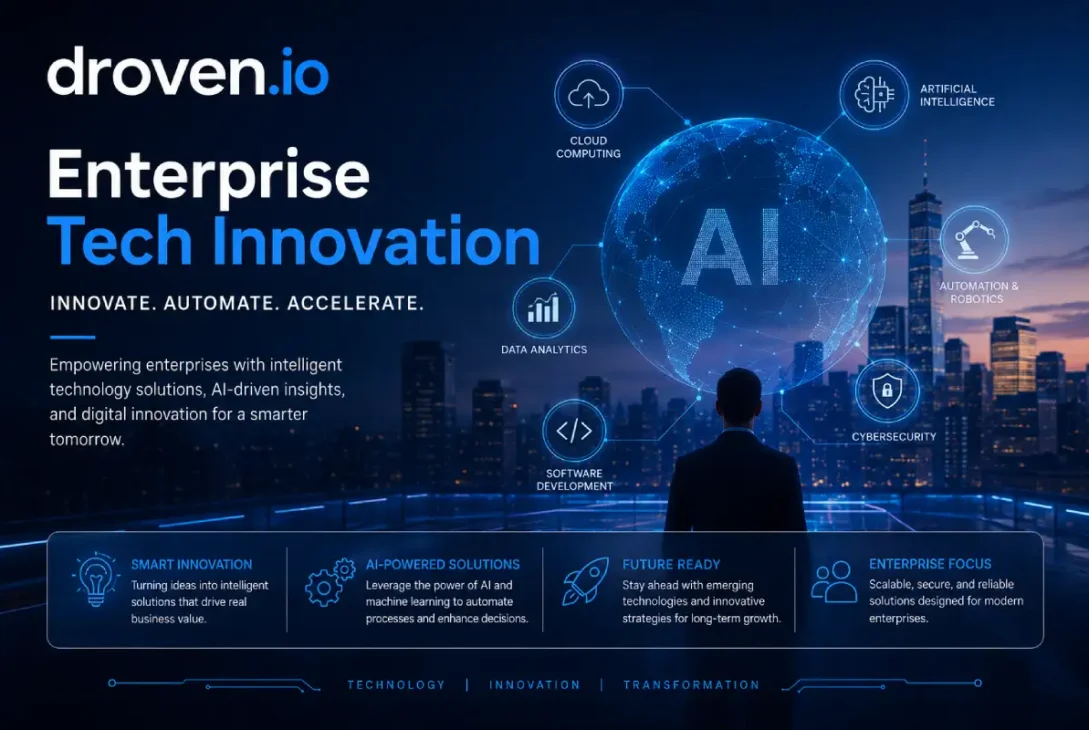
Technology is transforming business operations, the Competitive landscape, and how businesses connect with their customers. Businesses that in the past might have needed to build out significant human resources or complex IT infrastructure to complete tasks now leverage smart cloud-hosted platforms powered by AI, Automation, data analysis and digitally enabled connected experiences.
This is where the phrase “Droven.io enterprise tech innovation” becomes interesting. Based on Droven.io’s public website, it presents itself as an editorial technology platform covering artificial intelligence, emerging technologies, software development, digital transformation, innovation, and the future of work. It is better understood as a technology information and research platform, rather than as a standalone enterprise software product.
That distinction is important. A reader searching for Droven.io may expect a software platform, subscription service, or enterprise automation tool. Instead, the site provides technology-focused information intended to help readers understand rapidly changing subjects and business applications.
What Is Droven.io Enterprise Tech Innovation?

When associated with Droven.io, the phrase refers to the broader collection of enterprise technology subjects discussed through its content. These include AI, machine learning, generative AI, automation, robotics, software development, startups, and future technology. Droven.io’s own site currently organizes its content into eight broad categories: AI News, AI Tools, Machine Learning, Generative AI, Robotics, Startups, Development, and Future Tech.
The value of this approach is fairly simple: enterprise technology can be confusing when every new product arrives with its own terminology. A useful technology resource should help readers understand the underlying concept before they worry about choosing a particular tool.
That change in thinking is at the heart of meaningful technology innovation.
Why Enterprise Technology Innovation Matters

Enterprise technology is not simply about buying newer software.
Real innovation happens when technology changes the way work gets done.
A company might introduce automation into its finance department and reduce repetitive data entry. Another organization might use machine learning to identify patterns in customer behavior. A manufacturer could connect machines to sensors and analyze production data in real time.
In each case, the technology is only part of the story.
The bigger question is what happens after the technology is introduced.
A successful enterprise implementation should ideally produce a measurable improvement such as:
- Less repetitive work
- Faster decision-making
- Better customer service
- Lower operational costs
- Improved data visibility
- Stronger security
- Faster product development
- Greater scalability
This is why innovation should not be measured by how impressive a technology sounds. It should be measured by what changes in the real business.
The Main Technologies Behind Enterprise Innovation
Droven.io’s technology coverage provides a useful starting point for understanding several technologies that are increasingly important to modern organizations.
Artificial Intelligence
Artificial Intelligence (AI) is a branch of computer science concerning the simulation of intelligent behavior in computers. Artificial Intelligence computer programs are designed to perform tasks that have conventionally required the ability to distinguish a pattern, generate text, comprehend natural language, make forecasts or help to make decision.
In an enterprise environment, AI can appear in many forms.
Customer-service teams may use AI-assisted support systems. Marketing departments can use generative AI to create first drafts. Developers can use AI coding assistants. Finance teams can apply machine learning to identify unusual transactions.
The important point is that AI does not automatically create business value.
The strongest implementations connect AI to a clearly defined workflow.
Generative AI
Generative AI is a branch of artificial intelligence that creates new content from user instructions or other inputs.
That content may include:
- Text
- Images
- Code
- Audio
- Summaries
- Reports
- Structured information
Even for businesses, generative AI is interesting in that it can interact with human labor. People who spend a lot of time creating text, summarizing information, searching through data, or organizing existing documents could offload many of these tasks to this AI.
It’s crucial to have human monitoring for information relating to any sensitive subject matter, financial and/or legal matters, and customer interactions.
Automation
Business process automation uses software to handle routine tasks that would otherwise require a human. For instance, imagine an employee who receives hundreds of similar requests each week. If each request has a similar step-by-step workflow, then automation software could handle most of that workflow.
Automation can therefore shift employees away from repetitive administrative work and toward tasks requiring judgment, creativity, communication, or problem-solving.
Cloud Computing
With cloud technology, all companies can access computing assets such as applications, storage, servers, databases, etc through a network instead of setting up infrastructure on-site. IT organizations can find it easier, with the cloud, to provision the computing infrastructure at the scale needed as workloads change.
It also supports distributed teams and modern digital applications.
But moving to the cloud is not automatically a transformation strategy. A poorly designed cloud environment can still be expensive, complicated, or difficult to secure.
Data Analytics
Data analytics is the process of examining information to identify patterns, trends, relationships, and useful insights.
For enterprises, data analytics can answer questions such as:
- Which products are performing best?
- Where are customers leaving the sales process?
- Which operational activities consume the most time?
- What factors influence customer retention?
- Where are costs increasing?
Good analytics turns raw information into something people can act upon.
Cybersecurity
Cybersecurity refers to the practices and technologies used to protect systems, networks, applications, and data from unauthorized access, disruption, or misuse.
As organizations become more dependent on digital systems, security becomes part of innovation rather than an afterthought.
A new AI application, cloud migration, or automated workflow should therefore be evaluated alongside authentication, access control, privacy, monitoring, and governance.
Droven.io Enterprise Tech Innovation Compared With Traditional IT
The difference between traditional IT and innovation-focused enterprise technology is not necessarily that one uses technology and the other does not.
The difference is often how technology is connected to business goals.
| Area | Traditional IT Approach | Enterprise Tech Innovation |
| AI | Limited experimentation | Integrated into useful workflows |
| Data | Periodic reports | Continuous, connected insights |
| Automation | Simple repetitive tasks | End-to-end process improvement |
| Cloud | Infrastructure replacement | Flexible digital foundation |
| Security | Primarily defensive | Built into technology strategy |
| Employees | Technology supports existing jobs | Technology reshapes how work is performed |
| Innovation | Project-based | Continuous improvement |
This table should not be interpreted as saying that traditional IT is obsolete. Reliable infrastructure, databases, networks, and technical support remain essential.
Instead, enterprise innovation builds on those foundations.
How Droven.io Can Help Readers Understand Enterprise Innovation
The strongest role for an editorial technology platform is not necessarily to tell a company which product to purchase.
Its more useful role can be education.
Someone unfamiliar with machine learning may first need a basic explanation. A manager evaluating automation may need to understand the difference between robotic process automation and AI-based automation. A founder exploring generative AI may want to understand the opportunities and limitations before spending money.
Droven.io positions itself around this type of technology education. Its public description says the platform aims to explain AI, emerging technology, and modern business technology through researched and practical content.
That makes it useful as an early-stage research resource.
However, readers should still verify important technical, security, financial, and purchasing claims against primary documentation and official vendor sources before making major enterprise decisions.
Real-World Examples of Enterprise Tech Innovation
Customer Service
An organization can combine AI, automation, and customer data to help support teams respond more efficiently.
A basic chatbot might answer frequently asked questions. A more advanced system could classify incoming requests, retrieve relevant information, summarize the customer’s history, and send complex cases to a human representative.
The goal is not necessarily to remove people from customer service.
It is to give employees better tools.
Human Resources
HR departments handle large amounts of repetitive information.
Automation can assist with document processing, employee onboarding, scheduling, and routine communications. AI can also help organize information or summarize internal documents.
Human judgment remains important for sensitive employee decisions.
Software Development
Modern development teams increasingly use AI-assisted tools for coding, testing, documentation, debugging, and research.
This can shorten some development cycles, but generated code still needs review.
The best approach is usually human expertise supported by intelligent tools, rather than blindly accepting machine-generated output.
Manufacturing
Manufacturers can combine connected equipment, sensors, analytics, and AI to monitor production.
Instead of discovering a machine problem after failure, predictive systems can sometimes identify unusual patterns earlier.
That can support preventive maintenance and reduce unexpected downtime.
What Makes Technology Innovation Successful?
Buying technology is easy.
Changing an organization is harder.
Successful enterprise innovation normally requires several ingredients.
Start With the Problem
The first question should not be:
“Which AI tool should we buy?”
A better question is:
“Which business problem are we trying to solve?”
This single change can prevent a great deal of wasted effort.
Use Reliable Data
AI and analytics are only as useful as the information behind them.
Poor-quality, incomplete, duplicated, or outdated data can produce unreliable results.
Data preparation may be less exciting than launching an AI demonstration, but it is often more important.
Consider Security From the Beginning
Security should not be added after deployment.
Organizations should understand what information a system accesses, where that information goes, who can use it, and how access is controlled.
Measure Results
An innovation project should have measurable objectives.
For example, instead of saying:
“We want to introduce AI.”
A company could say:
“We want to reduce the time employees spend processing routine customer requests by 30%.”
The second statement provides something that can actually be evaluated.
Common Mistakes Businesses Make
Technology innovation can fail even when the technology itself works perfectly.
One common mistake is chasing trends without a business case.
Another is assuming that a successful small experiment will automatically scale across the entire organization.
Companies may also underestimate employee training, integration costs, security requirements, data preparation, and ongoing maintenance.
Perhaps the biggest mistake is treating innovation as an IT-only responsibility.
Technology affects operations, finance, sales, customer service, HR, compliance, and leadership. Successful transformation therefore usually requires cooperation across departments.
Who Can Benefit From Following Enterprise Technology Topics?
Droven.io’s technology focus can be useful to several types of readers.
Business owners can use technology explainers to understand emerging opportunities before investing.
Managers can explore how AI and automation could affect everyday workflows.
Developers may find technology and software-development topics useful when researching new tools and approaches.
Students and technology enthusiasts can use beginner-friendly explanations to build their understanding of fast-changing areas such as AI, robotics, and machine learning.
The site itself describes its intended audience broadly, including startup founders, developers, and people interested in technology innovation.
A Practical Way to Research Enterprise Innovation
If you are using Droven.io or another technology publication for research, avoid reading articles in isolation.
Instead, follow a simple process:
Step 1: Identify the business problem.
Know what you want to improve.
Step 2: Learn the technology category.
Understand what AI, automation, analytics, cloud computing, or another technology actually does.
Step 3: Explore potential applications.
Look for realistic use cases rather than impressive demonstrations.
Step 4: Compare alternatives.
Different technologies solve different problems.
Step 5: Verify important claims.
Check technical specifications, pricing, security statements, and performance claims against primary sources.
Step 6: Run a controlled test.
A small pilot can reveal problems before a company makes a large investment.
Step 7: Measure the outcome.
Determine whether the technology produced meaningful business value.
This process turns technology research into a decision-making exercise rather than a search for the newest trend.
The Future of Enterprise Tech Innovation
The next stage of enterprise technology is unlikely to be defined by one magical application.
Instead, several technologies are increasingly becoming connected.
AI can analyze information.
Cloud infrastructure can provide computing capacity.
Automation can execute processes.
Analytics can measure outcomes.
Cybersecurity can protect the environment.
Employees can provide context, judgment, creativity, and accountability.
That combination is more powerful than any single technology working alone.
This is why the idea behind Droven.io enterprise tech innovation is best understood as a broad technology ecosystem rather than one piece of software. Droven.io’s public categories span AI, machine learning, generative AI, robotics, development, startups, and future technology, reflecting the increasingly interconnected nature of modern digital business.
Final Thoughts
Enterprise technology innovation is ultimately about solving problems better.
AI may be the headline technology today, but successful transformation involves much more than artificial intelligence. Data quality, cloud infrastructure, automation, cybersecurity, software development, employee adoption, and business strategy all play a role.
Droven.io can be viewed as an information resource for exploring these technology subjects, rather than as an enterprise software product itself. Its public website focuses on technology and AI content, making it a useful starting point for readers who want to understand emerging technologies in a broader business context.
Also Read: https://www.nextleveltechie.com

 Welcome To Next Level Techie, For any queries you can contact us at :