

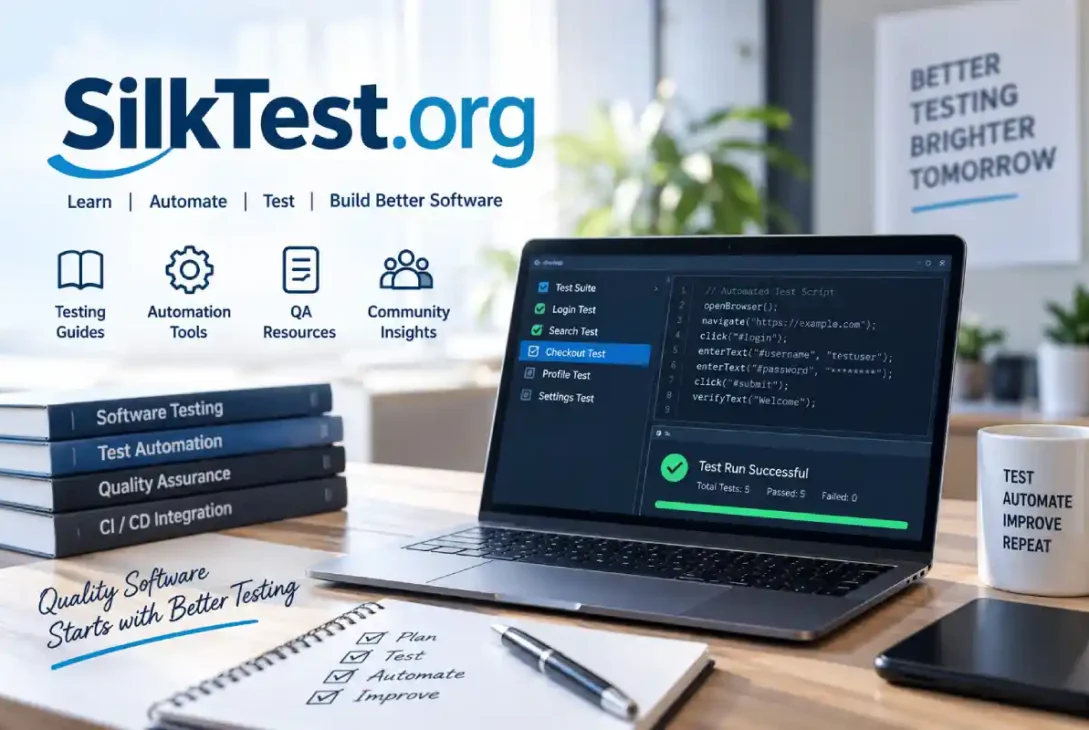
Information about every aspect of software testing, test automation, QA, tutorials, tools, and common issues related to software testing when you are on Silk Test.org. Get a platform with all this mentioned technology-related stuff not just because you are looking for geeks, but because you actually want to get to know things rather than learn through unsolvable, complicated topics.
For beginners, testing any product can be very complicated due to unfamiliarity with terms like test cases, automation frameworks, regression testing, scripts, CI/CD, and debugging.
What Is SilkTest.org?

Silk Test.org is a tech website about software testing, automation, and technology. The site features articles describing concepts such as automated testing, test scripts, functional testing, and troubleshooting. It also has recent information about automation workflows, CI/CD, and practical testing.
The name of the website is a little confusing, since it can be associated with a type of software testing technology; in that case, it’s better to keep the name separate from Silk Test software.
Testing in short: Software test automation is when software runs a set of predefined tests rather than a person doing the same things over and over again. For example, a script opens a website, enters login credentials, clicks a button, checks whether it sees the expected page, and reports the result.
Why Is Software Test Automation Important?

Modern applications can contain thousands of individual functions. Testing every function manually after each change can become slow and expensive.
Test automation helps teams repeat important checks consistently.
A typical automated testing process may involve:
- Creating a test case
- Defining the expected result
- Writing or recording test steps
- Running the test against the application
- Recording the result
- Investigating failures
- Updating the test when the application changes
The real value is not simply speed. Good automation also creates a repeatable process. A tester can run the same scenario today, tomorrow, and after the next software release while keeping the testing procedure consistent.
What Type of Information Can You Find on SilkTest.org?
SilkTest.org is a site that includes content about software testing and automation. Articles detail testing ideas and workflows, scripts, troubleshooting, and other technology-related topics. There is information that applies to novice automation users, as well as material for the more experienced QA person.
Some common areas include:
Testing Tutorials
Tutorial-style content can help readers understand testing concepts step by step. This is particularly useful for beginners who need examples before they can comfortably work with technical documentation.
Test Automation
Automation is one of the central themes associated with the website. Readers can learn about automated test cases, scripts, test execution, and ways of organizing larger testing workflows.
Troubleshooting
Not all tests always pass. A test might stop passing due to a real software defect, an unreliable test environment, an altered interface, or an incorrectly scripted test script.
Troubleshooting clues allow testers to differentiate between these situations instead of blindly assuming every test failure points to a product bug.
CI/CD and Modern Development
Recent SilkTest.org material also discusses connecting automated testing with CI/CD workflows.
What is CI/CD? CI/CD is the practice of continuous integration and continuous delivery/deployment, where code changes are built, tested, and prepared for release to production at any time. Automated tests can be included in the pipeline to give quick feedback to programmers.
SilkTest.org vs. Traditional Manual Testing
It is important to understand that automation does not completely replace manual testing.
Manual testing remains useful when a tester needs to explore an application, evaluate a new feature, inspect a user experience, or investigate unusual behavior. Automation is especially useful for repetitive tasks.
| Area | SilkTest.org / Automation Resources | Traditional Manual Testing |
| Repetitive tests | Well suited to automation | Can become time-consuming |
| Execution | Automated scripts can repeat tests | Tester performs each step |
| Speed | Useful for repeated regression checks | Depends on tester and test size |
| Human observation | Limited to programmed checks | Strong for exploratory testing |
| Maintenance | Scripts require updates | Test instructions require updates |
| Best use | Repeatable functional and regression testing | Exploration and human-centered evaluation |
The important point is that these approaches do not necessarily compete. Many professional QA teams use both.
Important Features of a Good Test Automation Approach
A strong automation strategy is more than recording clicks and running them later.
Stable Test Identification
Automated tests need reliable ways to identify buttons, fields, menus, and other application elements. If the identification method is fragile, even a small interface change can break the test.
Clear Assertions
An automated test should know what success looks like.
For example, simply clicking a Login button is not enough. A useful test should verify that the expected account page, message, or application state appears afterward.
Proper Synchronization
Modern applications frequently load information dynamically. A test that acts before an element is ready may fail even though the application is working correctly.
Using appropriate waits and synchronization methods can make automated tests considerably more dependable. Guidance published on SilkTest.org also emphasizes explicit waits rather than relying on arbitrary timing delays.
Useful Test Reports
A failed test is only helpful when the team can understand why it failed.
Logs, screenshots, error messages, and clear test names can make debugging much faster.
Who Can Benefit From SilkTest.org?
SilkTest.org can be useful for several types of readers:
- Beginners learning software testing
- QA testers exploring automation techniques
- Automation engineers looking for practical ideas
- Developers interested in automated regression testing
- QA leads planning testing workflows
- Students researching software quality assurance
Beginners should start with basic testing terminology before moving into complicated automation frameworks. Experienced testers, meanwhile, may find more value in troubleshooting, scripting, integration, and maintenance topics.
SilkTest.org: Pros and Considerations
| Pros | Considerations |
| Testing-focused content | Some topics may require prior technical knowledge. |
| Practical automation discussions | Readers should verify technical details against current official documentation. |
| Useful for beginners and QA professionals | Automation tools and environments can change over time. |
| Covers troubleshooting and testing practices | Not every testing problem can be solved through automation. |
| Includes technical guides and related resources | Older tutorials may require adaptation. |
An important note to be remembered here: Technology books should be viewed as learning guides, not the final word on how things work. Software versions, browsers, operating systems, API’s and testing tools are updated often. If you’re referencing a book that involves a specific product or version, looking at the original documentation is wise.
How to Use SilkTest.org Effectively
If you are visiting the site for the first time, avoid trying to read everything at once.
Start with a basic testing concept. Then move toward automation, test design, scripting, and troubleshooting. Once you understand the fundamentals, practical examples become much easier to follow.
A simple learning path could look like this:
Software testing basics → Test cases → Automation concepts → Test scripting → Regression testing → CI/CD integration → Debugging and maintenance
This approach is much easier than jumping directly into advanced automation.
Final Thoughts
Silk Test.org might be a good technology resource for readers interested in automation and testing. It covers concepts, automation, troubleshooting, scripts, and current development workflows. The single most important lesson for those new to automation: it’s not about removing testers. It’s about enabling technology to handle routine checks so people can focus on investigation, evaluation, usability, and more complex testing scenarios.


 Welcome To Next Level Techie, For any queries you can contact us at :