

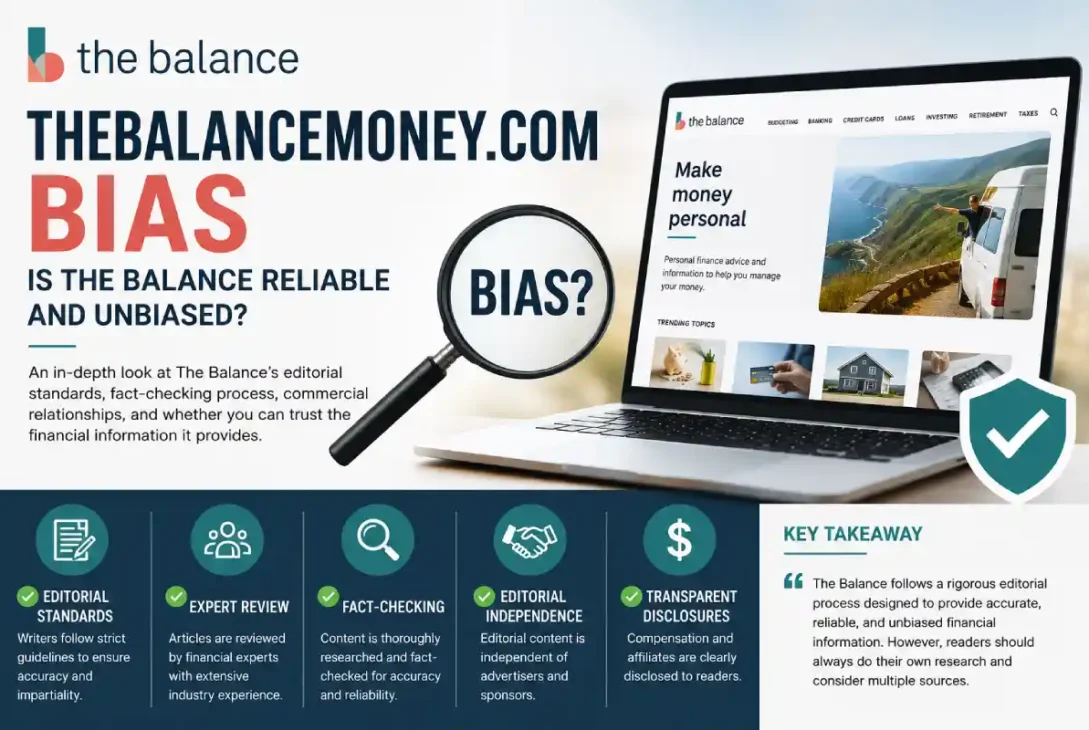
When someone searches for “The Balance money com bias,” they are typically asking one straightforward but vital question: Is the financial information published on The Balance accurate and trustworthy, or does the site support a specific political, financial, or commercial agenda?
It is a perfectly valid question. Personal finance is not just about dollars and cents. Articles on taxes, investment, inflation, policy, credit card charges, home loans, the economy, and related topics can affect a reader’s understanding of their world.
The Balance’s official website is described as a personal finance publication devoted to making financial topics understandable. It is a website with a stated editorial policy that directs writers and editors to provide accurate, helpful, and unbiased material, and an advisory Financial Review Board comprised of experts in various topics, from investment and taxation to economics, debt, and financial planning.
What Does “TheBalanceMoney.com Bias” Mean?

Bias – this simply means there is a bias in the site’s articles, advice, topics covered, language used, sources quoted, or presentation format that favors certain points of view. The presence of bias does not in and of itself imply a particular claim or advice is misinformation.
For example, an article can contain accurate statistics but still emphasize one side of an economic debate more heavily than another. Likewise, a financial article can be commercially useful while still following legitimate editorial standards.
There are several types of bias worth considering:
- Political bias: Favoring one political ideology or party.
- Economic bias: Presenting economic policies or theories more favorably.
- Commercial bias: Giving undue preference to a company, product, or advertiser.
- Selection bias: Choosing some topics, examples, or statistics while leaving others out.
- Framing bias: Using language that subtly influences how readers interpret information.
- Confirmation bias: Giving greater attention to information that supports an existing viewpoint.
This broader definition is useful because asking whether a website is simply “biased” can be too vague.
Is The Balance Left-Wing, Right-Wing, or Centrist?
Based on a perusal of the published editorial policies on The Balance itself, we see no convincing reason why it would deserve to be characterized definitively either as left-wing or as right-wing.
That distinction matters.
The Balance is primarily a personal finance and financial education website, rather than a political news organization Its content leans heavily on hands-on financial topics, saving, investing, banking, credit, taxes, retirement, mortgages, insurance, and various economic concepts.
According to its website, it endeavors to present objective, unbiased journalism, and its editorial content is not sponsored by any advertiser. It also says sponsored material is labeled separately.
That does not prove that every article is perfectly neutral. Instead, it tells readers what standards the publication says it follows.
A sensible reader should therefore avoid making a political classification based on one article or a handful of headlines.
The Balance’s Editorial Standards
One of the strongest ways to evaluate a financial website is to look beyond individual articles and examine its editorial process.
The Balance says its writers and editors investigate claims and verify information. It also says articles are reviewed by staff editors and fact-checked by staff or members of its fact-checking team.
The publication also says writers are expected to use primary sources, including government data, academic institutions, professional organizations, original research, and interviews with experts.
That is significant because financial information can become unreliable when articles simply repeat claims from other websites.
What Is Fact-Checking?

Fact-checking is the process of examining factual statements to determine whether they are supported by reliable evidence.
For a financial article, this could mean checking:
- Government statistics
- Tax rules
- Federal regulations
- Interest-rate information
- Academic research
- Official company documents
- Data from recognized financial institutions
- Statements from qualified experts
The Balance says these types of sources form part of its sourcing process.
Does Commercial Content Create Bias?
This is one area where readers should pay attention.
Advertising, affiliate programs, or commercial arrangements often pay for content for financial websites. This doesn’t mean their articles can’t provide reliable information, but it gives users a reason to pay attention to disclaimers. The Balance states that some links can pay a commission if you buy the resulting products and goes further to note that its content recommends not being biased by these arrangements.
In other words, there is a difference between:
“This website earns money when I click this link.”
and
“This website changed its recommendation because it was paid to promote that product.”
Those are not the same thing.
The Balance states that its writers and editors are required to disclose any potential conflicts of interest they may have and states that it does not allow for favored treatment due to any relationships with outside firms or resources.
TheBalanceMoney.com Bias: A Simple Comparison
| Bias Area | What to Look For | The Balance’s Stated Approach |
| Political bias | Favoring one political party or ideology | No stated partisan editorial position |
| Financial bias | Promoting a particular financial philosophy | Presents practical personal-finance information |
| Commercial bias | Favoring advertisers or affiliate partners | Says advertising is separated from editorial content |
| Source bias | Depending heavily on weak or anonymous sources | Says it prefers primary and qualified sources |
| Fact-checking | Unverified financial claims | Articles are reviewed and fact-checked |
| Conflicts of interest | Undisclosed personal or financial relationships | Contributors are expected to disclose conflicts |
| Product recommendations | Paid recommendations presented as independent | Says recommendations are editorially independent |
This table should be viewed as a summary of The Balance’s published standards, not as proof that every article is perfectly free from bias.
How The Balance Uses Experts
Financial topics can become complicated very quickly. A short article about retirement, for instance, may involve taxes, investment risk, inflation, withdrawal strategies, and regulatory rules.
That is why the credentials of the people reviewing financial content matter.
The Balance maintains a Financial Review Board made up of professionals with expertise across areas such as taxes, investing, debt, financial planning, and economics. The publication says the board has more than 100 years of combined financial experience.
According to the site’s explanation of its process, an article may be written by someone with expertise in the subject and then assigned to an appropriate review-board member. The reviewer examines the content for accuracy and relevance before the editorial team makes any necessary adjustments.
What Does a Financial Review Mean?
A financial review is an additional examination of financial content by someone with relevant professional knowledge.
It is different from simply checking spelling or grammar.
A financial reviewer may examine whether:
- A calculation is correct
- A financial term is being used properly
- A tax explanation is current
- An investment concept is accurately described
- Important qualifications or limitations are missing
- The article reflects current financial conditions
Readers may see a review indicator on some Balance articles when content has gone through this process.
Could The Balance Still Have Bias?
Yes. That possibility exists with virtually every publication.
Even when a newsroom has strong editorial rules, human judgment remains part of the publishing process.
Someone has to decide:
- Which stories deserve coverage
- Which experts should be interviewed
- Which statistics are most relevant
- Which examples should be included
- How a headline should be written
- How much background information a reader needs
- Which risks deserve greater emphasis
These choices can influence the way readers understand an issue without requiring anyone to deliberately publish false information.
That is why accuracy and neutrality should not be treated as exactly the same thing.
An article can be factually accurate while still presenting an issue from a particular angle.
Why Financial Articles Can Feel Biased
Financial subjects often involve disagreements rather than simple facts.
Consider an article discussing whether renting or buying a home is better.
One writer might emphasize mortgage payments, home equity, and long-term ownership. Another might focus on maintenance costs, property taxes, flexibility, and the opportunity cost of investing elsewhere.
Both could use accurate information.
Yet the final articles might leave readers with completely different impressions.
This is called framing.
What Is Framing Bias?
Framing bias occurs when the selection or presentation of information influences how an audience interprets an otherwise factual subject.
For example, describing inflation as “falling prices” would mean something very different from describing it as “prices continuing to rise at a slower rate.”
The underlying economic data may be identical, but the framing changes the reader’s perception.
This is why reading the headline alone is rarely enough when evaluating financial information.
Is The Balance Reliable for Financial Information?
The Balance appears to have several characteristics that make it useful as a general financial education resource.
Its published standards emphasize:
- Expert writers
- Editorial review
- Fact-checking
- Primary sources
- Conflict-of-interest disclosures
- Corrections
- Separation between advertising and editorial material
- Financial expert review
The publication also states that it will correct factual errors and provide transparent correction notices when necessary.
These are positive signs.
However, readers should remember that The Balance itself states that it does not provide individualized legal, tax, accounting, or investment services. Personal financial decisions can depend heavily on an individual’s circumstances.
So an article can be an excellent starting point without being a substitute for personalized professional advice.
How to Check a Balance Article Yourself
If an article involves an important financial decision, I would not rely on the website name alone.
Instead, check the article in a few simple steps.
1. Look at the author
Check whether the writer has relevant experience or qualifications.
A retirement article deserves a different level of scrutiny from a basic definition of compound interest.
2. Check the review information
Look for indications that the article has been reviewed by a financial professional.
The Balance explains that its Financial Review Board checks articles for accuracy and relevance.
3. Examine the sources
Ask where the numbers came from.
Government agencies, academic research, regulatory bodies, and original company documents are generally more useful than anonymous blogs repeating the same claim.
4. Check the publication date
Financial information can become outdated.
Tax rules change. Interest rates change. Credit-card offers change. Investment products change.
An older article can still explain a basic concept correctly, but current financial rules should be verified separately.
5. Compare important claims
If an article recommends a financial product or makes a significant claim about taxes, investing, loans, or government policy, compare it with another reputable source.
This does not mean assuming The Balance is wrong. It simply gives you a second perspective.
The Balance vs. Other Financial Information Sources
| Source Type | Main Strength | Main Limitation |
| The Balance | Accessible financial education | General information rather than personalized advice |
| Government websites | Primary rules and official data | Often technical and difficult for beginners |
| Financial regulators | Regulatory information and investor protection | Not designed primarily as beginner-friendly education |
| Academic research | Detailed evidence and methodology | Can be difficult for casual readers |
| Professional financial adviser | Personalized guidance | Advice may involve fees and individual conflicts |
| Financial blogs | Easy-to-read opinions and experiences | Quality and sourcing can vary widely |
The best approach is not necessarily choosing one source and ignoring everything else. For important decisions, cross-checking is usually stronger than blind trust.
The Balance Bias: What Should Readers Conclude?
So, what is the answer to the search query “thebalancemoney com bias”?
The evidence available from The Balance’s own editorial documentation does not support simply labeling the publication as a left-wing or right-wing financial website.
Instead, The Balance presents itself as a personal-finance publisher with editorial safeguards intended to promote accuracy, independence, fact-checking, expert review, and transparency.
That does not mean readers should assume every article is completely neutral or flawless.
A better conclusion is this:
The Balance can be a useful source for financial education, but individual articles should still be evaluated based on their sources, date, author, evidence, framing, and purpose.
That is a much more practical way to think about media bias.
Final Thoughts
Searching for the balance money comes with bias is actually a healthy habit. Financial information can affect real decisions, from choosing a credit card to planning retirement or deciding whether to take on a mortgage.
The Balance has published detailed standards outlining its approach to fact-checking, sourcing, corrections, conflicts of interest, advertising, and financial review.
Also Read: https://www.nextleveltechie.com


 Welcome To Next Level Techie, For any queries you can contact us at :