

Last Updated: September 8, 2026
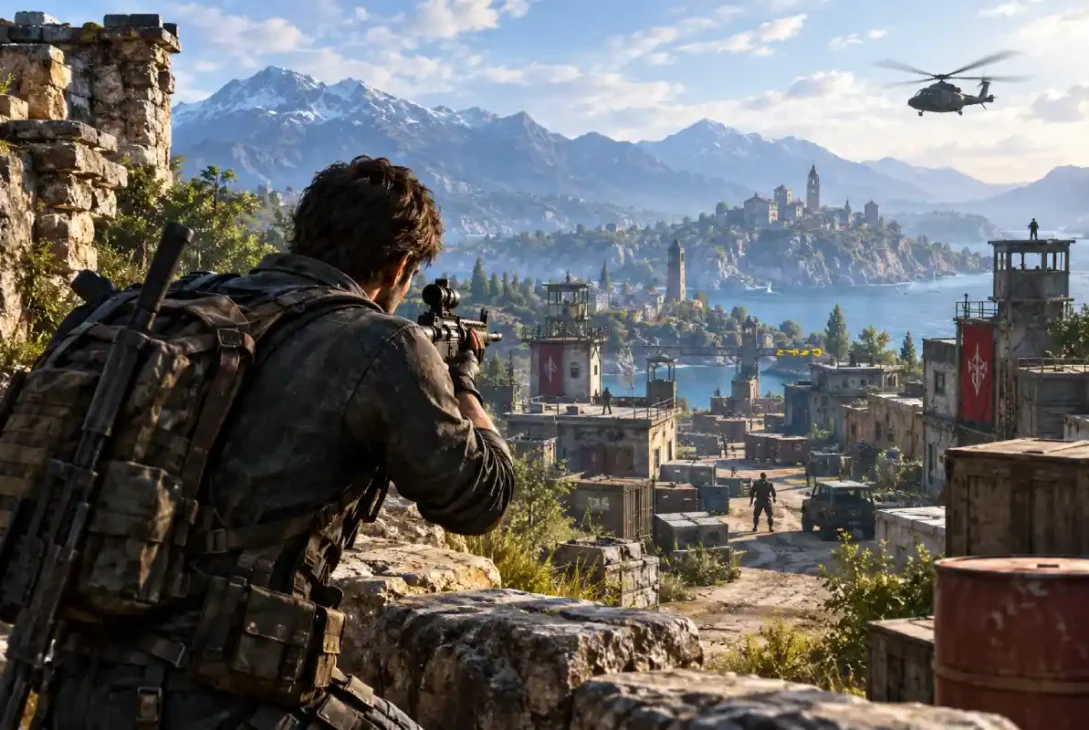
The TPS. TPS is a type of third-person shooter in which the player controls a character and can see over the character’s shoulder or from any angle behind them. This is, in contrast, the opposite of a first-person shooter, which enables the player to see the game through the eyes of the character whom it is playing as.
It allows the player to be a ‘fly on the wall’.
As with a first-person shooter, a significant aspect is, of course, shooting; however, now there is a more blended aspect of the TPS. Players now observe their player taking cover, climbing, jumping, and narrowly avoiding fire, while engaging in all sorts of other methods of survival: combat, melee/shooting weapons, with combat/puzzle and story/character advancement aspects involved.
What Is a Third-Person Shooter?
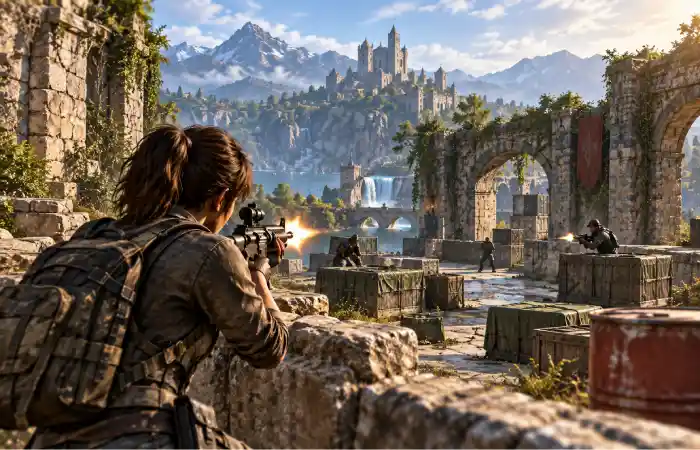
Third-person shooters are a video game genre that predominantly features shooting combat from a third-person view of the player character.This camera perspective is often placed behind the player, although the distance and angle at which it is set varies between games. Some games allow the player to manipulate the camera with relative freedom, whereas others employ limited and scripted camera angles with a cinematic presentation.
However, having guns alone does not render a video game into a third-person shooter. It does not make it automatically one. That aspect comes into play when coupled with both third-person controlled shooting and third-person characters; that is how the genre is created.
When the character model is fully visible, characters become more dynamic, and their movements have a greater impact on the playing environment. Darting around an enemy, taking cover, peeking around corners, or shifting positions in combat can be much more dynamic than in a first-person view.
How Does a Third-Person Shooter Work?
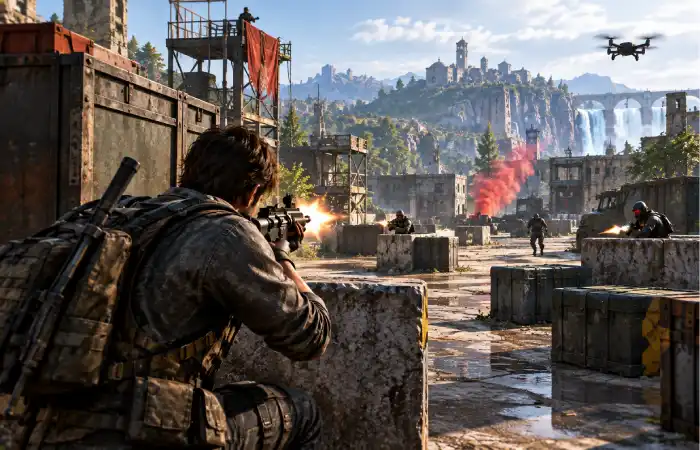
In most third-person shooter games, we see the action from behind a playable character. In the majority of third-person shooter games, you have a certain range of movement controlled with one of the analog sticks, and the camera aimed with another.
As in any shooting type of game, you probably spend most of the game scouting new areas for opponents, finding cover if needed, spotting enemies, aiming at your opponents to shoot them, and running for cover to heal. It all depends on the game, whether you will feel more encouraged to attack aggressively or to hold down a position patiently and use clever cover.
However, in third person shooters, the position of the camera can play a big role. Because the camera is behind our player character, you are very aware of your position in the environment.
Also, games can have over-the-shoulder views. In third-person shooters, the game view gets close to the character’s shoulder to help your precision while shooting without switching to a first-person view of the game entirely.
Key Features of Third-Person Shooters
Third-person shooters can vary enormously, but several features appear frequently.
Character-Based Camera
The most obvious characteristic is the camera: the world is viewed from the protagonist’s point of view, but in this game the camera is kept slightly behind or at another external vantage point.
These character animations are a large part of the experience. Reloading, running, crouching, and climbing, along with damage, are all visualized on the screen.
Gunplay
Shooting mechanics (most often a major system). Weapons might be handguns, automatic firearms, shotguns, sniper rifles, grenades and bombs, or futuristic guns/gear. The skill of third-person gun mechanics has a lot to do with more than just point and pull the trigger- accuracy, choice of weaponry, timing, behavior of enemies, and ammunition supply, and even player location all can influence the result of a firefight.
Cover Mechanics
Most third-person shooters have cover as one of the main gameplay systems: a player might press up against cover behind a wall or vehicles, or may be able to ‘stick’ to cover and move between a series of appropriate objects such as walls and crates. The flow of using cover results in a sequence of shoot-and-move to cover, move to new cover, and continue the fight.
Movement and Dodging
Visible movement is arguably more important in third-person games. The player’s avatar might roll, sprint, duck, scale ledges, leap across chasms, and execute dodge-rolls. For quickly-paced games, “when to shoot” can be “when not to move”.
Exploration
Although often centered on shooting stages, today’s third-person shooters are about more than that. They can offer exploration such as cities, woods, ghost towns, military bases, planet locations, and massive open-world arenas. Exploration gives items of worth such as weapons and collectibles, as well as places to reach and plot details and storylines to learn.
Third-Person Shooter vs. First-Person Shooter
The biggest difference between the two genres is the camera perspective.
| Feature | Third-Person Shooter | First-Person Shooter |
| Camera | Usually behind the character | From the character’s eyes |
| Character visibility | Full or partial character is visible | Usually only hands or weapon |
| Movement | Often emphasizes visible movement and positioning | Often emphasizes direct viewpoint control |
| Cover | Frequently important | Varies by game |
| Character animation | Highly visible | Less visible to the player |
| Aim perspective | Often over-the-shoulder or external | Direct first-person aiming |
Neither perspective is automatically better. The choice depends on the game’s design and what kind of experience the developer wants to create.
Different Types of Third-Person Shooters
The genre has grown beyond a single formula. Different games combine shooting with other gameplay styles.
Action Third-Person Shooters
These games generally emphasize fast-paced action. The player can potentially fight off large numbers of enemies and be constantly on the run from one place to the other. Explosions, weapon switching, hand-to-hand combat, and dynamic sequences are commonplace.
Tactical Third-Person Shooters
Tactical games put more emphasis on positioning and planning. You might have to track ammo or coordinate use of cover, coordinate team actions, and predict enemies. A thoughtless advance can cost the game, making patience particularly precious.
Third-Person Shooter RPGs
In some shooters, we can also find RPG mechanics like character levels, stats on equipped gear, skill trees, crafting, and weapon customization.
We, as players, are not just training to improve our aim; we may be building a character.
Third-Person Multiplayer Shooters
Allows people to play with or against each other. Types of multiplayer can include team matches, games that focus on specific objectives, team-based missions, or massively multiplayer games, with potentially huge numbers of players on each side. Requires more communication and fast reaction speed, as human players are unpredictable.
Why Do People Enjoy Third-Person Shooters?
The genre’s popularity is also due to the mix of character action and combat. A third-person view of the protagonist makes him more connected to the gamer, as many players believe. A properly implemented walking and running animation may even make moving the character feel good when he’s just going from one place to another.
The view also allows players to appreciate the action better by letting them see their character hop over obstacles, dodge, equip weapons, or react to what’s around.
Additionally, the genre has the advantage of being widely varied – a third-person shooter can be a straightforward action-adventure game, a tactical shooter, a sci-fi RPG game, a horror game, or even a competitive online game.
Third-Person Shooter Controls
The controls vary across different platforms and games, but in general, they include movement, camera control, aiming, shooting, reloading, jumping/dodging, and interaction with objects.
On a controller, one analog stick is typically used to control the character’s movement, with the other for camera control. The triggers and shoulder buttons are generally used for aiming and firing.
In a keyboard and mouse game, the movement of the character is controlled by a keyboard, and the camera is controlled by a mouse.
The intention of good controls would be to intuitively implement the above actions, so that when controlling the character, shooting at an opponent, and controlling the camera, the whole process would be flowing, allowing the player to enjoy the game by playing against the computer rather than the controls.
The Role of Storytelling
Third-person shooters are particularly well suited to cinematic storytelling because the protagonist remains visible throughout much of the game.
Developers can use body language, facial animation, movement, and environmental reactions to communicate personality and emotion.
Story-driven third-person shooters may include cutscenes, dialogue, character relationships, environmental storytelling, and carefully designed missions.
This allows the game to feel like more than a sequence of shooting challenges. The player can become invested in the character’s journey and the world surrounding them.
Is a Third-Person Shooter the Same as an Action Game?
Not necessarily.
A third-person shooter is defined primarily by its camera perspective and shooting-focused gameplay. An action game is a much broader category.
A third-person shooter can contain action-game elements, but it may also include stealth, role-playing, survival, exploration, puzzles, or strategy.
That flexibility is one of the reasons the genre has remained so adaptable.
What Makes a Good Third-Person Shooter?
A strong third-person shooter usually needs more than impressive graphics and a large selection of weapons.
The gunplay should feel responsive. Enemy behavior should provide a meaningful challenge. Camera movement should remain comfortable, especially during fast combat. Movement should feel reliable, and encounters should give players interesting choices.
Level design matters as well. Good environments give players opportunities to use cover, change positions, discover alternative routes, and experiment with different weapons.
Most importantly, the different systems should work together. Shooting, movement, exploration, story, and progression should feel like parts of the same experience rather than disconnected features.
Final Thoughts
The third-person shooter is in the business of shooting the world while viewing your playable character from an external perspective. What may have started as a simple deviation from existing shooter gameplay has blossomed into a vast genre capable of a plethora of gameplay styles, including tactical shooting, cinematic quests, RPG elements, exploration, stealth, and multiplayer domination. The third-person perspective does offer players one thing that first-person gaming cannot: a constant, tethered line of sight to the character they are guiding.


 Welcome To Next Level Techie, For any queries you can contact us at :