


Opa-Locka may be a small city located in northwestern Dade County in Miami, Florida, but Opa- Locka is not like most southern Florida cities for their style and heritage. Laid out by several designers around a fairy-tale idea in the 1920’s called an Arabian Nights city theme, the most eye-catching details could be seen in the city’s unique domes, minarets, arches, decorative buildings, and streets named after the Arabian fairy tale.
Occupying an area of around 4.2 square miles, Opa-Locka was officially chartered on May 14, 1926, after just 28 eligible registered voters began development. Aviation and entrepreneur Glenn Curtiss was deeply involved in this planned city.
Opa-Locka is an interesting city if one is fond of architecture, local history, transportation, and South Florida’s changing urban sprawl.
What Is Opa-locka?
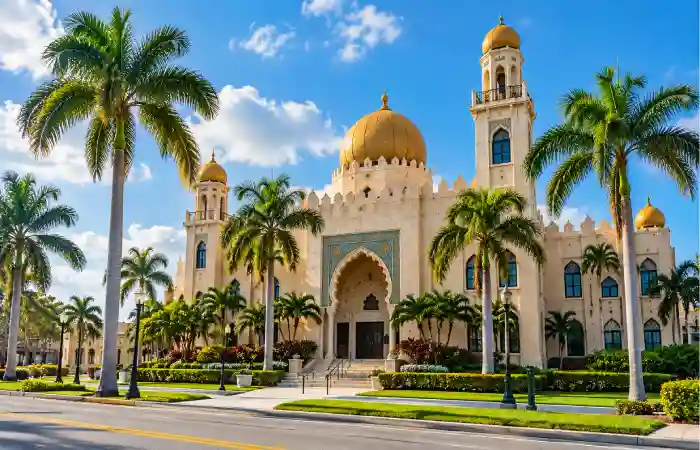
Opa-locka is a city in Miami-Dade County, Florida. It is a city that became somewhat infamous through its unusual 1920s design plan, its distinctively Moorish Revival buildings, and the idea of creating, as if part of a play, an exotic setting based on “One Thousand and One Nights,” a traditional title that appears beside the stories known as “The Arabian Nights”. The buildings were designed by architect Bernhardt Muller under a commission by Curtiss, and the town layout was designed by Clinton McKenzie.
It is quite fantastical; its buildings are decorated with onion domes, onion-shaped arches, tower-like structures, a very elaborate type of design, and various other parts and decorative elements, with the intended effect being clearly very alien to the normal American suburb.
The street signs also followed this theme; streets named Aladdin, Ali Baba, Sharazad, Sesame, Sinbad, and Sultan helped instill the sense of having been transplanted to another region.
The Meaning Behind the Name Opa-locka
Opa-locka does have Native American origins for its name, though. City history records have noted a previously recognized name of “Opa-tisha-wocka-locka”, described as a ‘humpy island’ which would take much effort to travel, “meaning wooded swamps and an island”. This name evolved into Opa-locka.
This creates an interesting circumstance where the city name predates the Arabian-themed construction; the Native American name and the Moorish construction are two distinct layers to Opa-locka.
How Opa-locka Was Created

Opa-locka was born during extraordinary growth in Florida in the 1920s. Glenn Curtiss, a famed figure in aviation, was active in South Florida real estate development.
Curtiss had enormous plans for Opa-locka: “Instead of merely building streets with houses along them, he planned not just a suburb, but a complete town with its own unique style.”
At the maximum size, the city design would provide hotels, an airfield, a golf course, an indoor swimming pool, a zoo, archery facilities, and a railway station. “The city thus served as much as a commodity to be advertised as any residential property”.
Opa-locka at a Glance
| Feature | Details |
| Location | Northwestern Miami-Dade County, Florida |
| Incorporated | May 14, 1926 |
| Founder | Glenn Curtiss |
| Architectural influence | Moorish Revival / Arabian Nights |
| Area | About 4.2 square miles |
| Major landmark | Historic Opa-locka City Hall |
| Transportation | Opa-locka Airport and Tri-Rail service |
| Historic significance | Numerous surviving 1920s Moorish-style buildings |
Why Opa-locka’s Architecture Is So Special
Architecture is probably the biggest attention-getter when coming into Opa-locka. Most of the first buildings were constructed using architects who specifically made them look like how they thought an Arabian city would look. Many domed roofs could be found everywhere among the city, and minaret-style towers and archways were located at every building to accent its appearance.
More than 100 of the houses and buildings designed by Curtiss and Muller feature domes and minarets and include exterior stairs.
The city of Opa-locka says that, due to the September 1926 storm, the city has retained several of its original buildings; 20 buildings from Opa-locka are currently listed on the National Register of Historic Places. The Opa-Locka Preservation Association states that Opa-Locka has the largest collection of Moorish Revival structures. The Historical City Hall of Opa-Locka stands prominently above most of the other city buildings. It includes ornamented tiles, archways, onion domes, and features that are designed to be seen as mini-minarets.
It was completed in 1926.
The Role of the Railroad and Airport
Transportation was fundamental in the original development of Opa-locka.
The Opa-Locka Station on the Seaboard Air Line Railroad, opened in the late 1920s, is a key element in understanding its association with the community’s exotic promotion of Arabian Knights imagery. It became a center of regional transportation and still operates today as a Tri-Rail Station.
The significance of Aviation tied to Curtiss can not be overstated.OPA’s Airport played an enormous part in its development story, and its utilization by the U.S. Navy as an Air Base stabilized the community after the war until the base closed in 1950.
Opa-locka’s History After the 1920s
However, with this incredible outset, the fortunes of the city rapidly turned. A 1926 hurricane hampered development when the boom of Florida real estate was beginning to wobble on its roots anyway. Much of the later development was sustained by the airport’s activity in the war years to the north, and only after the Navy’s departure did the city languish somewhat during a prolonged depression.
Through much of its troubled history, however, the city maintained something many communities lose after this long period of development/growth.
Opa-locka has retained a coherent identity with its history.
Opa-locka Compared With a Typical South Florida City
| Characteristic | Opa-locka | Typical South Florida Suburb |
| Architectural identity | Strong Moorish Revival influence | Often mixed modern styles |
| City planning | Planned community from the 1920s | Often developed across multiple periods |
| Historic landmarks | Significant collection of surviving themed structures | Varies widely |
| Street naming | Arabian Nights-inspired names | Usually conventional names |
| Cultural story | Closely tied to aviation, architecture, and planned development | Often more focused on postwar growth |
The comparison helps explain why Opa-locka attracts historical interest. Its character was intentionally created rather than simply developing by accident over decades.
What Can Visitors See in Opa-locka?
Visitors will find an experience of the unique buildings and landmarks in this community. The Opa-locka Preservation Association can fill you in on the history of existing buildings in this community and has a historical guide to tour within Opa-locka. The historic City Hall is obvious among all the significant buildings in this community, but also of interest in this community are the former Opa-locka Company Admin building and the historic railroad station.
The city is of great historical significance; to visitors, it is an architectural anomaly in this area.
“The Greater Miami Convention & Visitors Bureau places Opa-locka on their list of America’s distinctive communities and features the city’s surviving Moorish Revival buildings”.
Why Opa-locka Still Matters
Opa-locka is more than an unusual-looking city. It represents an ambitious chapter in Florida’s development history.
Its story combines aviation, real-estate development, architecture, transportation, city planning, and cultural identity in a remarkably small area. The city shows how developers in the 1920s experimented with creating communities that were not merely functional but also theatrical and memorable.
Its surviving architecture makes that history visible. Instead of reading about the 1920s only in books, visitors can still see domes, arches, towers, historic buildings, and streets that preserve the imaginative concept behind Curtiss’s original development.
Most importantly, Opa-locka demonstrates how a city can retain its personality even after periods of economic difficulty and major change. Its Moorish-inspired landmarks remain an unmistakable part of South Florida’s architectural landscape.
Final Thoughts
Opa-Locka has quite a tale to tell. With a name that hints at its Native American roots, Moorish Revival architecture, and ties to aviation pioneer Glenn Curtiss, it encapsulates a bold era in Florida history. Its domes, arches, minarets, and even Arabian-style street names bring to light the fantastically quirky vision that inspired this community.
Even though a variety of difficulties—including hurricanes—and the ebb and flow of the economy have taken their toll at times in its existence, its historical character remains intact as one of Miami-Dade County’s cultural treasures.
Also Read: https://www.nextleveltechie.com

 Welcome To Next Level Techie, For any queries you can contact us at :